
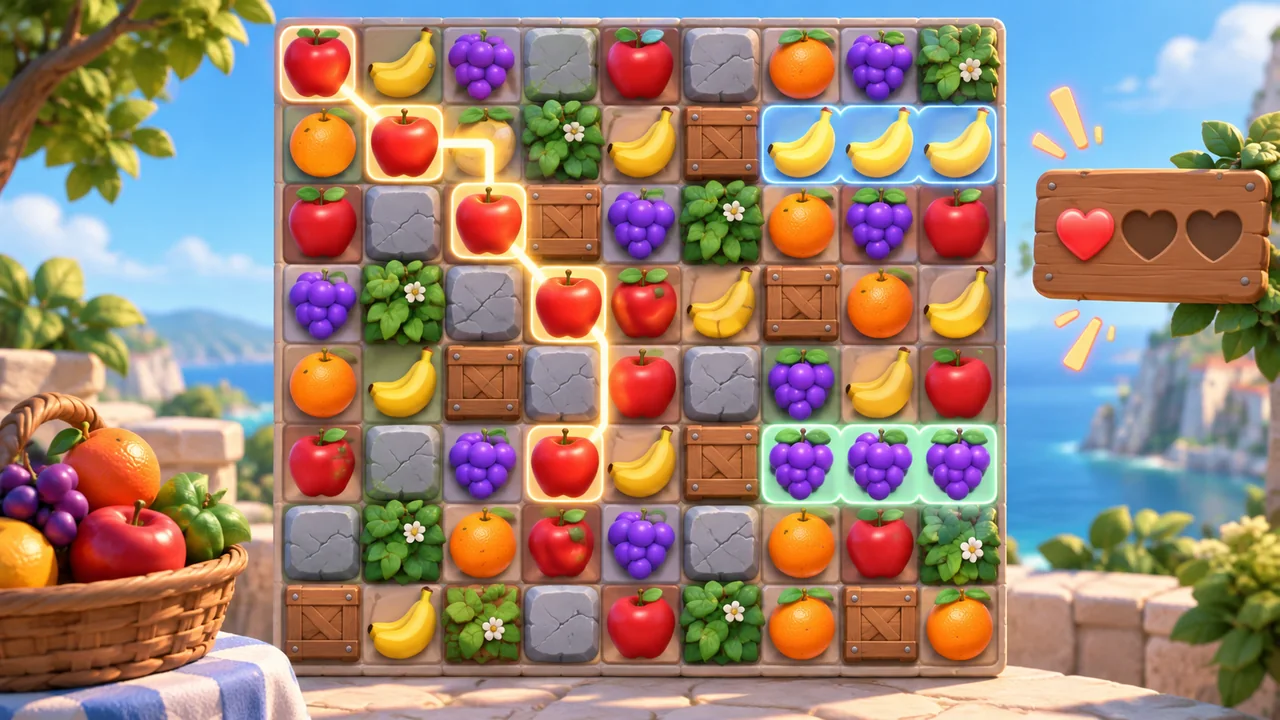
Fruit-match games look similar, but their goals can demand opposite decisions. A score level rewards efficient combinations; a collection level rewards access to required pieces; a blocker level rewards moves next to the obstacle. The reliable strategy is to identify the constraint first, then choose matches that improve both the objective and the next board.
Classify the level in five seconds
Look for four signals: the target icons, remaining moves or time, layered blockers and the direction new pieces enter. If the target is a particular fruit, preserve opportunities to connect that colour. If objects must fall to the bottom, protect open columns. If a spreading obstacle exists, decide whether it must be contained immediately.
Worked board: twelve moves, three crates
Suppose three crates block the centre and the goal is to collect six grapes. A ready-made grape match sits at the top, while an orange match beside a crate sits near the bottom. Taking the grapes gives immediate progress, but the orange match damages the crate, creates falling space and may bring more grapes together. With twelve moves, the access move is usually stronger. With one grape remaining and one move left, the direct match is obviously correct. Strategy changes with the remaining constraint.
Prefer lower matches when value is otherwise equal
A lower match affects more cells above it and therefore creates more chances for automatic matches and new connections. This is a useful tie-breaker, not a universal rule. A top match should still win when it directly clears the objective, stops a threat or creates the exact booster you need.
Do not chase random cascades
Cascades can be helpful, but they are not fully controllable. Judge a move by its guaranteed effect first and its likely reshuffle second. If a level requires a precise colour, avoid destroying a stable group solely in the hope that replacement pieces will be better.
Timed levels need a simpler plan
In timed play, use a short scanning loop: target area, bottom half, largest useful group, repeat. Avoid spending several seconds comparing distant moves unless the board is blocked. In move-limited play, take the extra moment to check gravity and combination effects. The visual pressure of a timer changes the best decision process even when the board rules are identical.
Handling bombs, cages and spreading obstacles
Countdown pieces usually deserve priority when their failure state ends the level. Cages and layered blockers matter when they prevent target pieces from moving. Spreading obstacles are dangerous because the cost of waiting can increase each turn. Always follow the in-game tutorial for exact behaviour; names such as “jelly,” “sugar” and “bomb” do not guarantee the same rules across titles.
Review a failed attempt constructively
Ask which resource ran out: moves, time, open space, target pieces or booster access. Then change one part of the plan. If you ran out of moves with blockers remaining, prioritize access earlier. If target fruit never connected, stop spending that colour on small matches. This creates a testable adjustment instead of blaming luck alone.
The restored Candy Monsters archive shows how several of these objectives appeared in one historical game.
Colour scarcity and target preservation
If a level needs one fruit type, count how many are visible and how many are trapped. Clearing that fruit in tiny groups can prevent a larger required match later. Preserve scarce pieces when they are near connection, but do not protect them so rigidly that the board loses space. The best preservation move also improves access or creates a useful fall.
When reshuffling is informative
A game may reshuffle when no legal moves remain. Do not deliberately force that state unless the rules make it safe: reshuffles can preserve blockers, move targets away from useful lanes or consume time. However, an involuntary reshuffle tells you the board had become over-constrained. On the next attempt, open central space earlier and avoid isolating single fruits behind obstacles.
Two-turn planning exercise
Before tapping, name the move you expect to make next. Then ask what new pieces or falls could invalidate it. If the next move depends on one uncertain replacement tile, the plan is fragile. If it depends on opening a column or joining two visible groups, it is more robust. This simple exercise trains forward planning without requiring exhaustive calculation.
Limits and version differences
Match-3 games vary in whether diagonal pieces count, how many items create a booster, whether automatic matches consume objectives and how obstacles react. The visual language can look familiar while the rules differ. Treat the current game tutorial as authoritative and use this guide for prioritization rather than exact numerical thresholds.
How this guide was produced
The editorial team compared common puzzle objective patterns, separated version-specific rules from general decision methods, and used hypothetical worked examples rather than claiming access to an unverified current build. Submit corrections through Contact.