
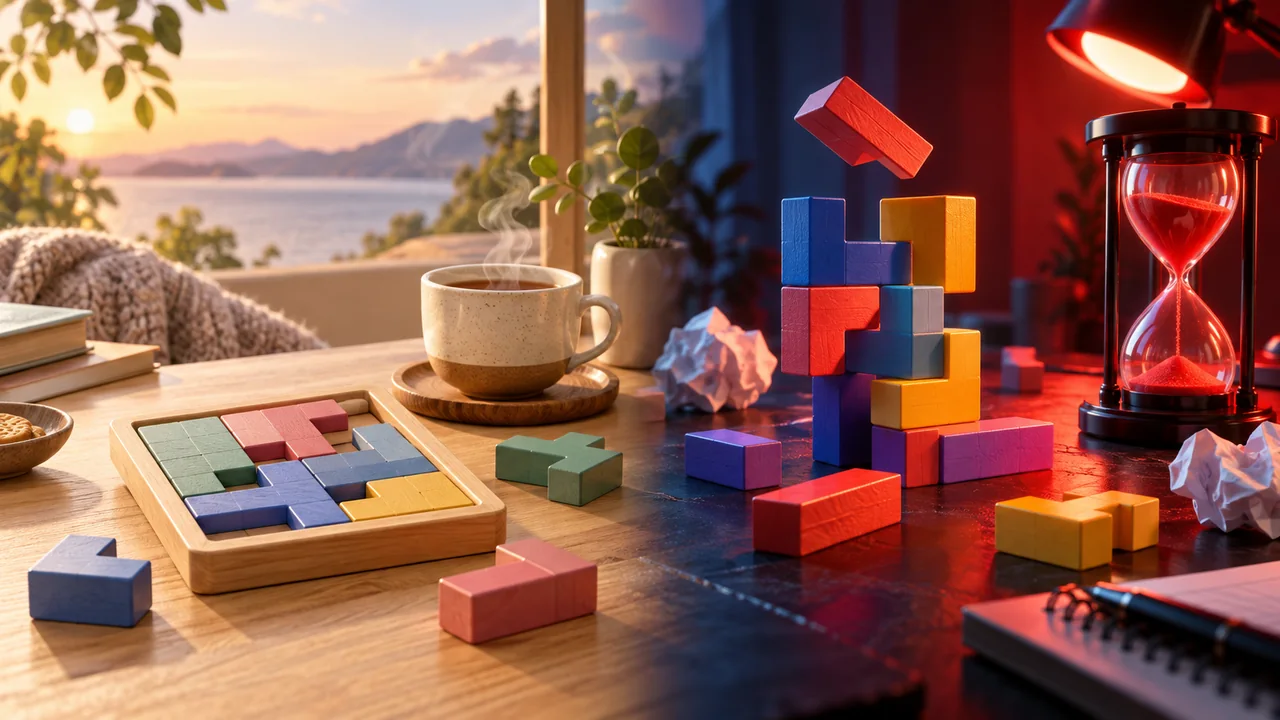
Choose an untimed puzzle when you want deliberate problem solving or expect interruptions. Choose a timed puzzle when quick recognition and pressure are part of the fun. Move-limited games sit between them: the clock is relaxed, but every action carries a cost.
Three pacing models
Untimed puzzles let you inspect the board without an explicit penalty. Move-limited puzzles allow unlimited thinking time but restrict actions. Timed puzzles make decision speed part of performance. Many casual games mix these models across level types, so one title can feel calm in one session and demanding in another.
Worked scenario: playing during a commute
A player on a train may have five minutes but also face announcements, stops and interruptions. A 90-second timed level fits the nominal time window, yet interruption can make it frustrating. A move-limited level is easier to pause and resume because thinking time is not consumed. At home, the same player may prefer the timed mode because the pressure creates focus. “Casual” describes accessibility of entry, not one universal pace.
Attention and accessibility
Timers can disadvantage people who need more time to perceive colour, read small goals or execute precise touches. Good games use clear shapes in addition to colour, readable objective counters, a pause function and effects that do not obscure the board. Players sensitive to pressure should look for pause controls, untimed modes and settings for motion, sound and haptics.
Monetization changes the experience
A timer can be a neutral design constraint, but it can also be tied to paid extensions or consumable boosters. Evaluate whether the game explains the cost before commitment, whether a level can be learned through normal attempts, and whether advertisements interrupt concentration. This is an editorial judgement about player fit, not a claim that all paid extensions are unfair.
How to test a game quickly
- Play several early levels without spending a booster.
- Note whether failure teaches you something or merely blocks progress.
- Try pausing or backgrounding the app safely.
- Check whether objectives remain readable during effects.
- Review purchase and ad prompts before a child uses the device.
A single tutorial level is not enough evidence because early stages are designed to be forgiving. The better test is whether later rules remain understandable and whether difficulty comes from decisions rather than hidden information.
Our recommendation
For reflective planning, interruptions or accessibility needs, start with untimed or move-limited play. For short focused sessions and players who enjoy rapid recognition, timed levels can be satisfying. Games such as the historical Candy Monsters used multiple goal types, which is useful for variety but makes settings and clear rules especially important.
Pressure can come from more than a timer
A game without a countdown can still create pressure through limited lives, streak rewards, expiring events or prompts to buy extra moves. Conversely, a timed mode with a pause button and no penalty for retrying may feel fairer than a move-limited level tied to scarce consumables. Evaluate the complete loop around the puzzle, not only the icon beside the score.
Try a three-session comparison
Play the same mode once when focused, once during a realistic interrupted setting and once without optional boosters. Record whether failure came from misunderstanding, execution speed or a monetized resource. A mode that is enjoyable only under ideal conditions may not fit your normal routine. A mode that remains clear and recoverable across sessions is a stronger long-term choice.
Signs that challenge is readable
- The objective is visible before and during the level.
- A failure screen explains what remained rather than only offering a purchase.
- Timers pause when the app is legitimately paused or backgrounded, if the platform supports it.
- Visual effects do not hide legal moves or countdown pieces.
- Difficulty increases through combinations and constraints that were previously taught.
Limits of this comparison
Pacing preference is personal and can change with context, age, motor control, vision and stress. This page does not rate a specific current app or make a health claim. It provides criteria a player or family can apply while observing the actual game and its settings.
A final practical test is whether you willingly return after a normal failure. If the pace leaves you curious about a better decision, the challenge is probably serving the puzzle. If it leaves you rushing only to protect a streak, close a prompt or recover a scarce resource, the surrounding pressure may be a poor fit even when the underlying board is enjoyable. Choose the mode whose failure teaches you something useful.
How this guide was produced
The editorial team compared common puzzle objective patterns, separated version-specific rules from general decision methods, and used hypothetical worked examples rather than claiming access to an unverified current build. Submit corrections through Contact.